Abstract
The digital presentation of AI can obscure the physical systems it depends on and may help improve. This paper examines manufacturing, agriculture, weather forecasting, and energy through a common framework: sensing conditions, forming a useful model, choosing an action, and observing its consequences. The literature supports meaningful applications while revealing limits imposed by data quality, equipment, local context, and system boundaries. I argue that AI’s contribution to the physical economy is strongest when prediction is connected to a feasible, safe intervention. I also examine the energy required to provide AI services, distinguishing all data-center demand from AI-specific demand and projections from observations. The central proposition is that computational abundance becomes material progress only when it respects the stubborn realities of the world outside the model.
The cloud has an address
The phrase “in the cloud” is a remarkable piece of linguistic camouflage. It makes a system of buildings, power supplies, cooling, cables, chips, and maintenance staff sound like a weather condition. AI arrives through a clean interface, but its operation remains physical. So do many of its most important applications: producing food, maintaining equipment, moving goods, and balancing energy systems.
This matters because the physical economy has different failure conditions from a document editor. A mistaken paragraph can often be revised before publication. A mistaken setting on a machine may damage equipment or injure someone. An agricultural recommendation may encounter conditions the model never observed. The world is not obliged to accept a software system’s assumptions simply because its output is well formatted.
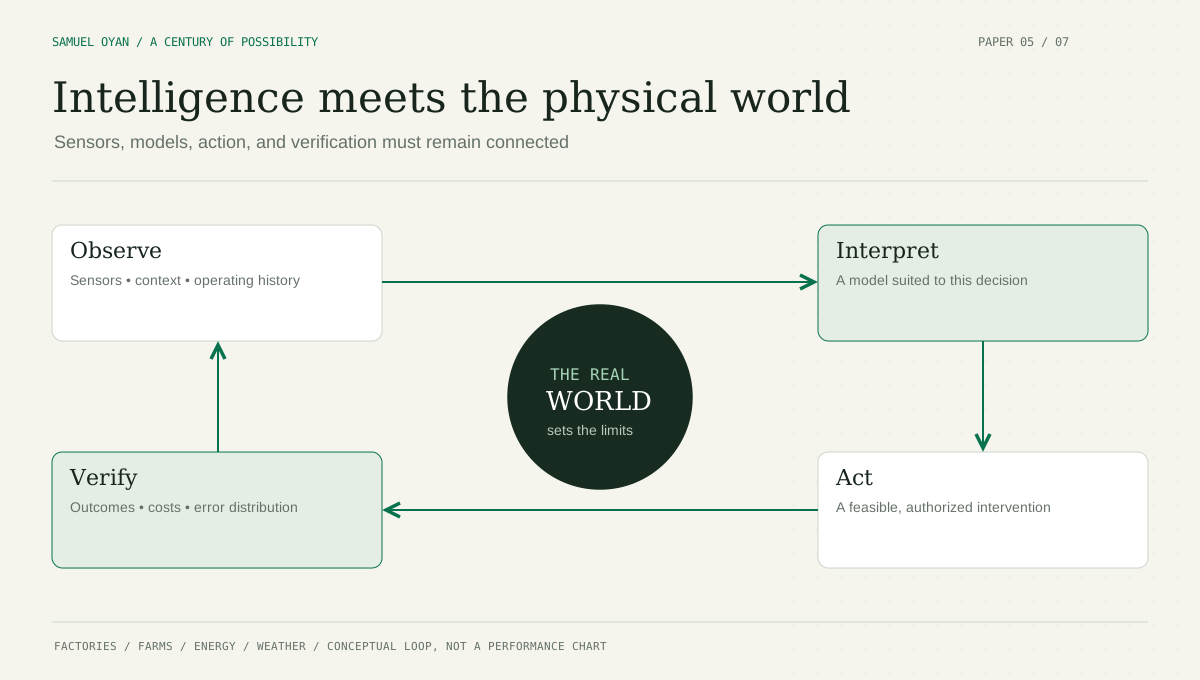
The argument here is that AI’s material value comes from a completed loop: observe, interpret, act, and check. Each link depends on local conditions. A better prediction helps only if a relevant action is possible and its cost is justified. This framework connects several industries without pretending that a farm, a factory, and an electrical network are interchangeable.
A machine can be understood before it fails
NIST’s manufacturing discussion identifies applications including inspection, predictive maintenance, and digital models of equipment and processes [1]. These are categories of use, not a guarantee of a particular return on investment. Their common opportunity is to connect information about a production system to decisions that are difficult or expensive to make through observation alone.
Predictive maintenance illustrates the mechanism. Signals such as vibration, temperature, or operating history may support an estimate of deterioration. That estimate becomes useful when maintenance can be scheduled before an unacceptable failure, without replacing healthy components too early. The relevant outcome is reliable productive capacity at a reasonable total cost, including inspection, parts, downtime, and false alarms.
An illustrative factory might detect an abnormal pattern with excellent statistical confidence but still be unable to obtain a replacement component. Another might have spare parts but unreliable sensor calibration. The same model cannot solve both problems by producing a more confident alert. Deployment requires an understanding of the action pathway, including what the organization can do when the system raises a concern.
The digital twin is a model, not a magical duplicate
A digital twin is useful when its representation of an asset or process is accurate enough for a defined purpose and connected to relevant information. The term should not imply a perfectly faithful copy of reality. Some twins use AI; others rely on different modeling methods. A model suitable for planning energy use may be unsuitable for certifying the safety of a mechanical change.
The important questions are which variables are represented, how the model is updated, how uncertainty is handled, and what decisions it is allowed to inform. A sophisticated visualization can create unwarranted confidence if these questions remain unanswered. A beautiful dashboard may be an excellent window. It can also be a very expensive painting of a window.
For a high-consequence intervention, simulation should support rather than replace the appropriate physical evidence and engineering review. This is not an argument against models. It is an argument for using them precisely. Their value comes from disciplined relationships with the systems they represent, including knowledge of where those relationships become weak.
The farm is a local problem at global scale
FAO’s work on agricultural automation places digital tools within a longer transition that includes mechanization, economic constraints, and unequal capacity to adopt [2]. AI can potentially help identify crop stress, target inputs, or support planning. But the value of a recommendation depends on the crop, soil, weather, equipment, labor, financing, and information available in that setting.
Consider an illustrative irrigation assistant. It might combine sensor readings and a forecast to recommend when to water. The recommendation is only useful if sensors are reliable, the farmer can control irrigation, water is available, and the expected gain exceeds the intervention’s cost. A missing sensor or unreliable pump is not a minor detail. It can determine whether the proposed intelligence has any practical effect.
Small producers may benefit from shared services, cooperatives, or tools that work with limited connectivity and modest equipment. Those are deployment choices rather than automatic consequences of lower model costs. A service designed around the resources of a large industrial operation can widen disparities if it is later advertised as a universal solution without adaptation.
The environmental question is equally contextual. More precise application of an input may reduce waste per unit of output. Total resource use can still rise if production expands or the saved resource is used elsewhere. Evaluations should specify whether they measure efficiency, absolute consumption, environmental harm, or profitability. These measures can move in different directions.
Forecasting the sky without claiming to control it
GraphCast research published in 2023 demonstrated strong medium-range global weather prediction in a defined evaluation against an operational deterministic forecasting system [3]. This is evidence that learned models can make valuable forecasts. It is not evidence that every local hazard, rare event, or future climate condition is covered equally well, nor that a forecast replaces official warnings or emergency institutions.
The distinction between prediction and preparedness is essential. A better estimate of a storm’s path helps only when it reaches the people making decisions, arrives with usable uncertainty information, and connects to transportation, shelter, communications, and public trust. A technically impressive forecast that arrives too late for action is a scientific achievement with an incomplete public benefit.
This also shows why AI and physical science need not be treated as rival religions. Learned models can depend on data produced through observation and physically informed analysis. Physical understanding helps evaluate whether results are plausible and where generalization might fail. A productive scientific system uses different instruments to challenge and improve one another.
Energy is both an application and an input
AI can support parts of energy-system operation by helping interpret information, anticipate conditions, and identify maintenance needs. But giving a model direct control over a critical process introduces additional engineering and security obligations. A recommendation, a simulation, a supervised adjustment, and an autonomous control action should not be grouped under the same evidence requirement.
The energy needed to operate AI also belongs in the account. The IEA’s 2026 analysis projects roughly 950 terawatt-hours of global data-center electricity consumption in 2030, compared with about 485 in 2025 [4]. Those figures concern data centers overall, not AI alone. The 2030 number is a projection, sensitive to assumptions about demand, efficiency, applications, and infrastructure.
The report makes clear why one energy-per-query number cannot represent every AI use [4]. A brief text request, a long reasoning workflow, and video generation are different workloads. For public evaluation, the useful question is the energy and material cost of a valued service, including its scale, rather than a detached comparison that treats all interactions as equivalent.
Efficiency improvements can lower the cost of each task and encourage more tasks. This is a possible rebound mechanism, not proof that efficiency is pointless. It means total impact depends on both intensity and volume. An institution should ask whether the resulting work creates enough benefit to justify the resources it consumes and whether a simpler method could achieve the same outcome.
A framework for material value
| Stage | Question | Common deployment failure |
|---|---|---|
| Observe | Are the inputs representative and reliable? | Sensors drift or conditions differ from the training setting. |
| Interpret | Is the model useful for this decision? | A good average score hides costly local errors. |
| Act | Can an authorized, safe intervention occur? | The organization lacks parts, capacity, or a suitable control path. |
| Verify | Did the outcome improve at acceptable total cost? | The pilot counts predictions rather than real effects. |
This loop also changes how pilots should be designed. Begin with a physical or operational outcome, such as fewer unplanned failures or better use of a constrained input. Establish the existing performance and the relevant alternative. Then measure the intervention as a whole, including staff time, missed events, unnecessary actions, maintenance of the AI system, and effects on people beyond the organization.
A prototype that works in a clean demonstration must still face wear, missing data, unusual operating conditions, and the occasional employee who has kept a machine alive for fifteen years using methods absent from the manual. Local expertise is not an obstacle to intelligent automation. It is often information about the real system that the deployment has not yet captured.
The strongest objection: are these just old ideas with a new label?
Many useful approaches described here predate current generative AI. Statistical forecasting, industrial automation, optimization, and machine vision have long histories. That objection is a reason for precise terminology. The paper does not claim that a chatbot invented predictive maintenance or that every digital system needs a language model. New capabilities should earn their place against simpler, proven alternatives.
The novelty may lie in improved prediction, a more usable interface, better transfer between representations, or a cheaper way to integrate knowledge. Sometimes there will be no meaningful novelty for a particular use. A credible adoption strategy allows that outcome. The objective is a better physical system, not maximum participation in a fashionable category.
A future built from both atoms and algorithms
The past century expanded the ability to produce, transport, measure, and coordinate. AI can contribute to the next stage by helping people interpret complexity and choose better interventions. Its contribution will remain entangled with energy, materials, skilled workers, infrastructure, and local knowledge. Software may update overnight; a transmission line, a crop cycle, or a replacement turbine follows a different clock.
This is the gravity of the transition: computation is increasingly able to participate in decisions that shape the material world. The opportunity is substantial, but so is the obligation to connect claims to real outcomes. A more intelligent model is valuable when it helps produce food, reliability, safety, or resilience that people can actually experience. The physical world is the final reviewer, and it does not accept citations in place of results.