Abstract
The last hundred years are often narrated as a parade of remarkable inventions. This paper offers a different interpretation: the decisive achievement was the accumulation of systems that allowed people to amplify one another’s capabilities. Electrical infrastructure expanded productive power; medicine and public health changed the conditions of survival; computers made complex calculation reusable; networks made information mobile; and AI is making some forms of analysis and generation available through ordinary language. Drawing on historical institutional records and research on general-purpose technologies, I argue that AI is a continuation of this cumulative process and a change in how people access it. Its importance lies in a lower barrier between intention and technical action. Its social value still depends on institutions, distribution, reliability, and human choice.
A visitor from 1926
Imagine introducing a visitor from 1926 to an ordinary smartphone. Do not begin with the camera. Begin with the fact that the object can identify its position, retrieve a distant library, transmit a moving image, translate a conversation, and help someone write a computer program. Then explain that its owner mainly uses it to lose an argument with strangers before breakfast. The joke contains a serious point: spectacular technical capacity and wise human use have always been different achievements.
The visitor would not come from a world without technology. In 1926, industrial machinery, telephones, electrical networks, motor vehicles, and radio already existed. Their availability differed sharply by geography and income. Starting the century with an empty stage would erase the people and systems that made later advances possible. The relevant question is how capabilities became cheaper, more connected, more dependable, and accessible to more people over time.
I use 1926 to 2026 as a historical frame, not as a claim that technological history divides neatly into hundred-year chapters. The argument is cumulative. Each generation inherited instruments, knowledge, organizations, and failures that it could recombine. The century’s most important product may therefore be a larger space of possible action: more things a person or institution can plausibly attempt, although access to that space remains unequal.
The century was a stack, not a ladder
A ladder suggests that a newer technology replaces the rung beneath it. A stack is closer to reality. AI depends on computation; computation depends on semiconductor manufacturing; manufacturing depends on energy, materials, precision equipment, and accumulated science. Networks depend on physical infrastructure and shared protocols. Remove the lower layers and the apparently weightless digital economy becomes a collection of expensive furniture.
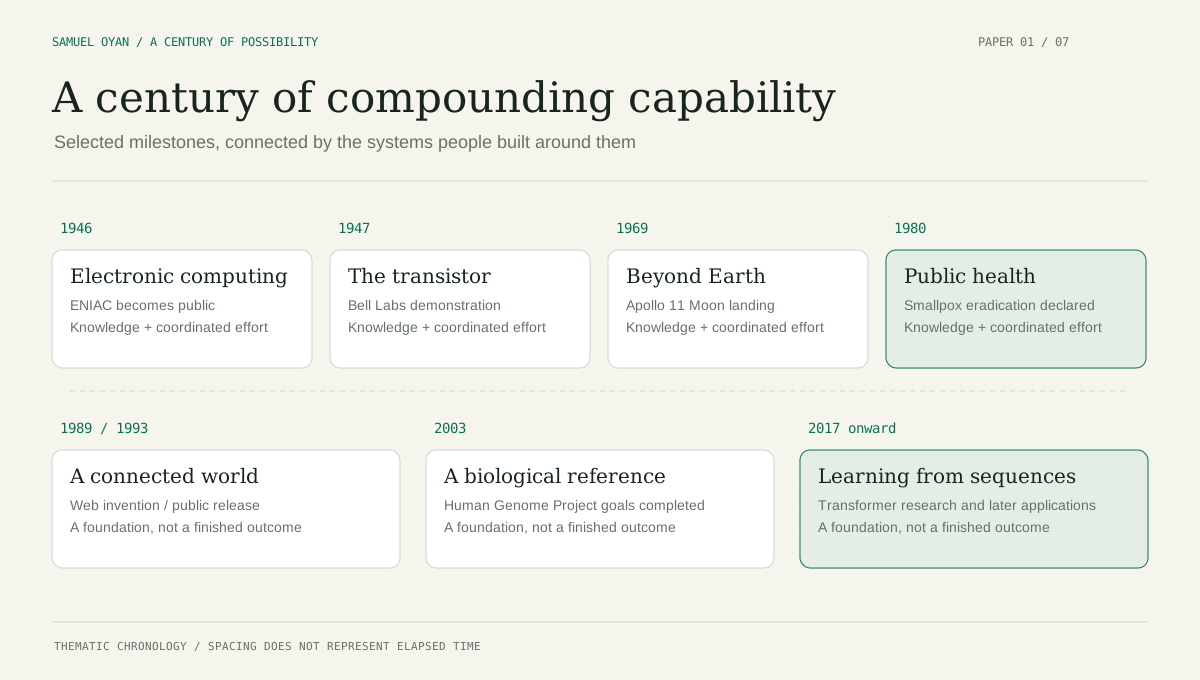
ENIAC’s public emergence in 1946 and Bell Labs’ transistor invention in 1947 mark different layers of this stack: electronic computation and a device that helped make electronics smaller and more practical [1] [2]. Their importance cannot be reduced to a comparison between one old machine and one modern phone. The deeper change was the ability to manufacture, program, maintain, and distribute computation across many settings.
The same pattern appears in communication. CERN records the Web’s invention in 1989 and the release of its software into the public domain in 1993 [3]. The Web did not invent the internet, and neither made every society equally connected. It provided a usable way to link and navigate information over existing networks. An architectural decision about access and interoperability helped turn a technical system into a public medium.
| Milestone | Capability added | What still had to be built |
|---|---|---|
| 1946: ENIAC becomes public [1] | Electronic calculation at a new scale. | Programming methods, manufacturing, maintenance, and usable applications. |
| 1947: Bell Labs transistor [2] | A foundation for smaller, practical electronics. | Reliable production, integrated systems, and supply chains. |
| 1969: Apollo 11 [4] | Coordinated human travel to the lunar surface. | Long-term access, safety, and a sustainable mission purpose. |
| 1980: smallpox eradication declared [5] | A disease removed from natural circulation. | Continuing public-health capacity and preparedness. |
| 1989 / 1993: Web invention and public release [3] | Linked information over networks. | Connectivity, usability, trust, and equitable access. |
| 2003: Human Genome Project completes its goals [6] | A foundational reference for genomic research. | Interpretation, representative data, clinical evidence, and access. |
| 2017 onward: transformer-based advances [7] | A major architecture for learned sequence processing. | Reliable applications, evaluation, and accountable deployment. |
Human progress also happened outside the screen
A history centered only on chips and software is too narrow. The 1980 declaration of smallpox eradication demonstrates a different kind of technical achievement: scientific knowledge organized into sustained public-health action [5]. A vaccine in a laboratory and an eradicated disease are separated by surveillance, logistics, training, trust, financing, and people willing to reach communities that a spreadsheet might otherwise overlook.
Apollo 11’s 1969 Moon landing and the Human Genome Project’s completion in 2003 likewise show that progress is organized cooperation [4] [6]. The latter met its original goals without making every region of every human genome fully understood or every disease treatable. A milestone can be extraordinary without being final. History becomes more useful when achievements retain their actual scope rather than becoming slogans about problems supposedly solved forever.
These examples connect because they changed the relation between knowledge and possibility. A disease could become preventable at population scale. A destination beyond Earth could become reachable. Biological information could become a shared research resource. None of these outcomes came from a lone device acting independently. They emerged when instruments, institutions, and human effort were arranged to make a difficult result repeatable.
What is distinctive about the AI turn?
The transformer research introduced in 2017 supplied an influential architecture for sequence modeling [7]. It is one important contribution in a longer AI history, not the invention of all artificial intelligence. Modern systems combine learned models with training data, computation, software, interfaces, and sometimes tools. Treating the chat window as the whole technology is like describing a railway by looking only at the ticket counter.
My central claim is about the interface between people and capability. Earlier digital tools often required a person to learn a specific command language, application, or workflow. Language-based AI can accept an incomplete request, propose a representation of the problem, and generate a candidate result. That lowers some entry costs. It does not remove the need for domain knowledge, source checking, or judgment about consequences.
A useful distinction is between retrieving an existing answer, generating a plausible answer, and taking an action. Those operations can appear in the same conversation while carrying different risks. Finding a public train schedule differs from inventing an explanation of a delay; both differ from buying a nonrefundable ticket. The interface may look continuous even when the underlying responsibilities change abruptly.
This helps explain the gravity of the present moment without pretending that machines have become omniscient. A society can be substantially changed by making imperfect capabilities widely available. Cheap printing did not require every printed page to be true. Cheap computational generation does not require every generated answer to be correct. In both cases, abundance changes who can produce information and how others must evaluate it.
Why invention and transformation run on different clocks
Research on general-purpose technologies emphasizes broad application and complementary innovation [8]. The productivity J-curve literature adds that organizations may need substantial investment in processes, skills, and other intangible assets before a powerful technology produces visible gains [9]. A company cannot reliably obtain a new operating model by attaching an AI subscription to an unchanged approval maze.
The implication is easy to miss. A model demonstration may improve in minutes; a hospital’s procurement, evidence review, staff training, and integration may take much longer. That difference is not automatically institutional incompetence. Some delays protect patients, workers, and public money. Others preserve obsolete arrangements. The task is to distinguish necessary friction from inherited friction instead of calling every obstacle either wisdom or resistance.
Consider an illustrative small manufacturer. It might generate maintenance instructions quickly, yet still lack trustworthy equipment records, spare parts, or a technician available to act. Here the binding constraint is somewhere else in the system. Technology creates value when it moves the constraint or helps the organization work around it safely. A faster answer that cannot be used is potential, not completed progress.
Progress for whom?
The phrase “we have come so far” deserves an immediate question: who is included in “we”? ITU’s 2025 estimates put roughly three-quarters of the world online while about 2.2 billion people remained offline [10]. These are dated connectivity estimates, not a live 2026 head count. They establish why global technological possibility cannot be equated with universal practical access.
Access also extends beyond a connection. A useful service must be affordable, available in a language a person understands, usable with a disability, and compatible with local institutions. An agricultural model that assumes reliable sensors and constant connectivity may be poorly suited to a farmer who has neither. Innovation becomes development when its supporting conditions reach the people expected to benefit.
Nor does a technical improvement settle the distribution of rewards. Greater productivity can support lower prices, higher wages, shorter working time, higher profits, or some combination. Decisions about ownership, competition, bargaining, and public provision affect that allocation. Saying that a tool increases what society can produce is different from saying that everyone will receive a fair share. The second proposition requires its own explanation.
The strongest objection to this account
A critic could argue that this story gives too much coherence to an untidy century. Wars, environmental damage, surveillance, and displacement also accompanied technical expansion. That objection is correct if “progress” is used as a moral verdict on everything technology enabled. I use it more narrowly to describe expanded capabilities, then ask whether those capabilities improved human conditions and how their costs were distributed.
A second objection is that AI may prove less economically transformative than its advocates predict. This remains possible. The argument here does not depend on a particular growth forecast or a date for human-level general intelligence. Systems that alter the cost of drafting, searching, coding, classification, or coordination already create consequential design choices. Their full economic magnitude remains an empirical question rather than an entitlement granted by enthusiasm.
What “forever changed” should mean
The world has changed in a durable sense when new capabilities alter expectations and the choices institutions must make. A student, employer, patient, or government can no longer assume that fluent digital material was produced in the old way. That does not mean every task is automated, every profession disappears, or the future has one predetermined path. It means the background conditions for judgment have shifted.
The century’s lesson is therefore neither complacency nor panic. Human beings have built an astonishing capacity to extend perception, coordinate effort, and turn knowledge into action. We have also repeatedly discovered that power arrives before consensus about its use. The next achievement must be to build institutions that make expanded capability useful, accountable, and broadly accessible. A more capable civilization is an opening. A better civilization is the work that follows.