Abstract
Generative AI changes the economics of explanation without abolishing the difficulty of learning. This paper argues that the important educational distinction is between assistance that improves the production of an answer and assistance that develops an enduring capability in the learner. Contrasting randomized studies in undergraduate physics and high-school mathematics shows why tutor design, task structure, and evaluation conditions matter. I propose three complementary modes of assessment: independent understanding, transparent use of tools, and reasoned defense of a decision. The paper also examines teacher workload, accessibility, language, privacy, and the risk of weakening the path from novice to expert. The aim is an educational response that makes powerful assistance available while preserving the practice through which people become capable of judging it.
A library that talks back
For much of modern education, access to information was a practical constraint. Books, laboratories, teachers, and institutional opportunities were unevenly distributed. Networks made far more material reachable; generative AI added an interface that can explain, reformulate, and respond. The change is significant. A learner may ask the same basic question repeatedly without worrying that the assistant has begun checking the clock.
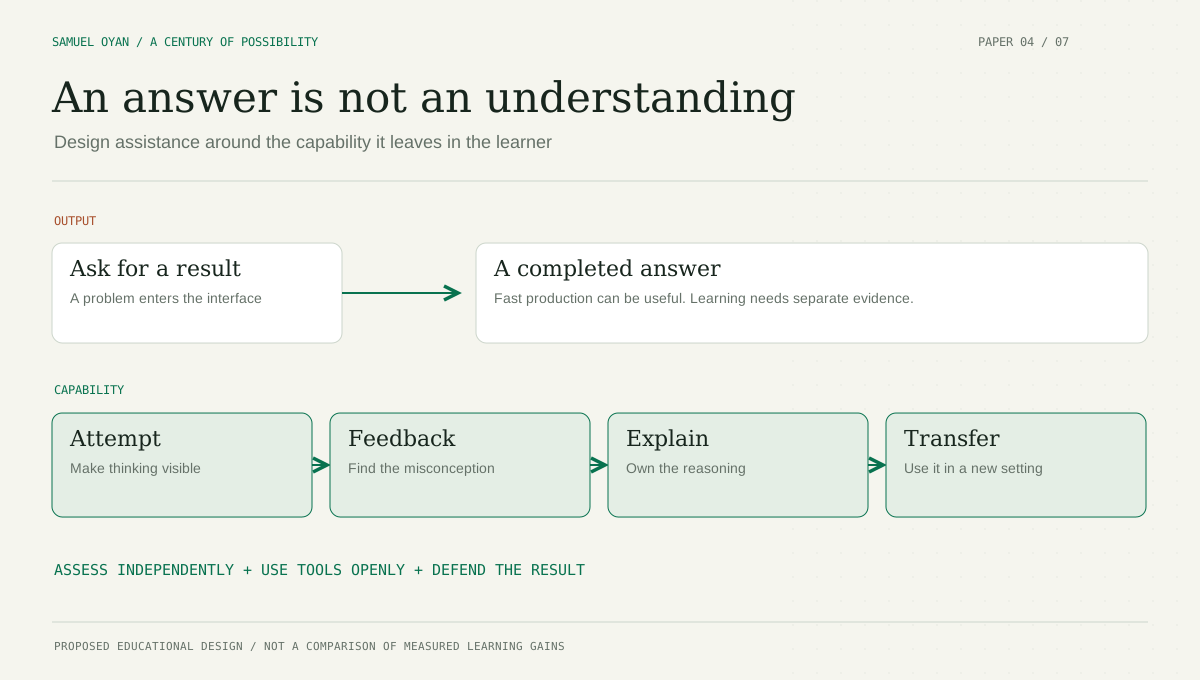
Yet a system that always has another answer can conceal whether the learner has acquired one. A polished solution is an object. Understanding is a capability in a person. Schools and universities have sometimes used the first as evidence of the second because the connection was reasonably informative. AI weakens that shortcut. Education must therefore become more explicit about what the student is supposed to be able to do.
My argument is that educational AI should be judged by the capabilities it leaves behind. Convenience can support learning, but it can also bypass it. The relevant question is not whether students use tools. It is which parts of intellectual work the tools support, which parts they perform, and whether the student becomes more able to reason when assistance is unavailable or mistaken.
Two studies, a more useful disagreement
Kestin and colleagues’ 2025 randomized study compared a structured AI tutor with active classroom learning in an undergraduate physics course involving 194 eligible participants. The study reported stronger measured learning in its AI tutoring condition [1]. It evaluated a designed intervention and particular material; it did not establish that an unrestricted chatbot replaces teachers across subjects, ages, or educational settings.
Bastani and colleagues’ 2025 high-school mathematics research, in contrast, found that unrestricted generative assistance could improve assisted practice while harming later unassisted performance; a tutor designed with learning safeguards changed that pattern [2]. The result concerns a specific experiment. It is not evidence that every form of AI use damages learning or that every safeguard guarantees durable understanding.
These findings are more useful together than as rival slogans. “AI tutor” can refer to substantially different products. One may require attempts, provide hints, and sequence explanations. Another may hand over a completed solution. Both can produce fluent conversation. Their educational effects need not be similar because they allocate the learner’s work differently.
The generalization I draw is conditional: design choices influence whether AI complements practice or substitutes for it. This is an interpretation of the studies, not a new experimental finding. It also leaves important questions open, including long-term retention, transfer to unfamiliar problems, variation across students, and the effect of repeated use over months rather than a small number of lessons.
The answer is not the exercise
Suppose a student asks for help solving an algebra problem. An answer-producing assistant can remove every obstacle. A learning-oriented assistant may instead ask the student to explain the first step, identify an error, or compare two possible methods. The second interaction may feel slower. That delay can be part of the educational purpose rather than a defect in the interface.
A gym that offers to lift every weight for its members would provide excellent logistics and questionable training. The analogy has limits: cognitive work does not map neatly onto muscles, and assistance can be essential for accessibility. But it captures a basic design issue. Some effort is wasteful friction; some is the activity through which the desired capability develops. Good educational design must tell the difference.
This distinction should not romanticize confusion. A student who is completely lost may need a direct explanation, a worked example, or a different representation. Productive difficulty is not the same as abandonment. The goal is calibrated support: enough assistance to make progress possible, combined with opportunities to attempt, explain, check, and eventually act independently.
What a teacher contributes when explanations are cheap
A teacher’s work includes much more than delivering information. It involves choosing goals, interpreting confusion, organizing discussion, setting expectations, evaluating progress, and recognizing when a student’s difficulty is not primarily academic. An AI system may assist with parts of that work. It does not follow that the relationship, responsibility, or professional judgment has become unnecessary.
An illustrative teacher might use AI to draft examples at different levels of complexity, then inspect them for accuracy and relevance. This could reduce preparation effort if verification remains manageable. The same system could increase workload if it creates a flood of plausible but unsuitable material. The relevant measure is usable teaching capacity, not the number of lesson plans a system can generate.
There is also a difference between personalization and isolation. A learner may benefit from an explanation adapted to their current understanding, while still needing disagreement, cooperation, and exposure to other people’s perspectives. A classroom is not merely an inefficient delivery system for private tutoring. It is also a social setting in which people learn to reason together.
Assessment after fluent output becomes abundant
The familiar take-home essay remains useful when its purpose is clear. It becomes less reliable as a standalone proxy for unaided writing or reasoning if a student can submit generated work without demonstrating understanding. The response should improve assessment rather than assume every polished paragraph is suspicious. An accusation based on writing style can punish improvement and misread students who use legitimate language support.
I propose three assessment modes. In independent mode, learners demonstrate selected capabilities without the relevant assistance. In tool-supported mode, they use AI openly, document consequential choices, and verify results. In defense mode, they explain their reasoning, respond to questions, and adapt a result to a changed condition. The modes answer different questions; none should carry the entire evaluation alone.
| Mode | Capability being tested | Evidence to request |
|---|---|---|
| Independent understanding | Reasoning the learner can perform without the relevant AI assistance. | A bounded solution, explanation, or transfer task. |
| Transparent tool use | Choosing, directing, and checking assistance responsibly. | Sources inspected, errors corrected, and significant decisions documented. |
| Reasoned defense | Owning and adapting the result under questioning. | Explanation of tradeoffs and response to a changed assumption. |
For example, a student could submit an AI-assisted policy brief, identify the sources they checked, defend a recommendation in discussion, and complete a short independent analysis of a related problem. This is a proposed design, not a validated universal recipe. Its value is that it makes the intended evidence visible: responsible use of assistance and personal command of the underlying reasoning.
Literacy now includes knowing when the machine is guessing
AI literacy should include understanding that fluency, confidence, correctness, and authority are different properties. Students need to check whether a source exists, whether it supports the claim, whether a calculation is sound, and whether the system has information appropriate to the question. These are not specialist programming skills. They are practical habits of inquiry in an environment where plausible material is cheap.
The same literacy includes recognizing limits of one’s own knowledge. A person cannot verify everything equally well. A useful educational response teaches when to seek an expert, when a source is insufficient, and when uncertainty should remain in the answer. Intellectual maturity sometimes appears as a carefully bounded claim rather than an especially impressive paragraph.
There is a temptation to teach prompting as if the correct wording unlocks reliable knowledge. Prompting can improve an interaction, but it cannot supply missing evidence by magic. A well-phrased question sent to an unsuitable system can still return an unsuitable answer. Students need models of investigation, comparison, and verification in addition to techniques for requesting output.
Equity cannot be reduced to a subscription
UNESCO’s guidance emphasizes human-centered educational use, privacy, inclusion, and the development of human capacity [3]. Those priorities become concrete when schools decide which students receive reliable tools, what information may be entered, and how alternatives work. A child should not have to surrender sensitive personal details simply to receive help with a difficult lesson.
ITU’s 2025 connectivity estimates also remind us that access to digital assistance rests on unequal infrastructure [4]. Even a free model may require a usable device, bandwidth, electricity, a suitable language interface, and someone able to help when it fails. A deployment that ignores those conditions can reward already advantaged learners while describing itself as universally available.
Accessibility requires particular care. Translation, alternative explanations, or assistance with expression can expand participation. Removing all such support in the name of authenticity can be unfair. Assessment should distinguish the capability being tested from barriers irrelevant to that capability. The objective is an honest account of what the learner knows, not a ritual of identical conditions that measures different things for different people.
The apprenticeship problem
Professional learning often begins with tasks that experienced workers find routine: preparing a first draft, examining a simple case, or explaining a standard procedure. If AI performs all of this introductory work, institutions must create another path through which novices develop judgment. A workforce cannot maintain expert review indefinitely while quietly dismantling the process that produces experts.
This is a proposed risk mechanism rather than a forecast of inevitable skill decline. Organizations could use AI to enrich practice, provide varied cases, and expose learners to feedback sooner. They could also use it to eliminate opportunities to practice. The outcome depends on training design and incentives. The important question is whether a learner’s responsibility grows alongside their capability.
The future classroom should make thinking more visible
A strong objection is that independent assessment may preserve skills that technology has made less important. Education should indeed reconsider its priorities. Not every historical exercise deserves permanent protection. But deciding which skills can be safely delegated itself requires an account of what people must understand to detect failure, make judgments, and participate in society. Convenience alone cannot make that decision.
The appropriate goal is neither a classroom sealed against AI nor one that treats generated answers as learning. It is an environment in which assistance expands opportunity while practice builds durable human capability. A student should leave better able to ask a precise question, examine a claim, revise an explanation, and defend a decision. The most important educational output remains the person who can think after the screen goes dark.