Abstract
AI is often compared with electricity, but the comparison is useful only if it explains a mechanism. This paper argues that AI becomes infrastructure when organizations can depend on particular cognitive services, combine them with other systems, and govern their consequences. Drawing on research about general-purpose technologies, organizational investment, and workplace assistance, I distinguish model capability, task performance, workflow outcomes, and social value. The evidence supports meaningful gains in specific settings, alongside uneven performance and substantial integration costs. I propose a bottleneck-based approach to adoption: identify the constraint on a valued outcome, test whether AI can move it, and measure the additional work and risk created. The central issue is how intelligence becomes dependable organizational capacity rather than a series of impressive demonstrations.
The electricity analogy needs a wiring diagram
Calling AI “the new electricity” can illuminate a transformation or conceal an argument that has not yet been made. Electricity mattered because people could use it across many activities, build complementary equipment around it, and increasingly depend on its delivery. AI will not gain comparable importance merely because a presentation contains a lightbulb. The analogy must explain application, complementarity, reliability, and access.
The general-purpose technology literature offers a starting point: some technologies improve over time, serve many uses, and stimulate further innovation across sectors [1]. Applying that framework to AI is an analytical judgment, not proof that every current model has the same economic role as an electrical grid. The more useful question is which services can become reusable foundations for other people’s work.
Examples include extracting information from documents, translating between formats, identifying patterns, proposing code, and helping a user navigate a complex procedure. These are capabilities with different reliability requirements. An advertising draft can tolerate revision that a payment instruction cannot. An organization therefore needs a portfolio of bounded services rather than one undifferentiated promise to “add intelligence.”
Four levels that should never be confused
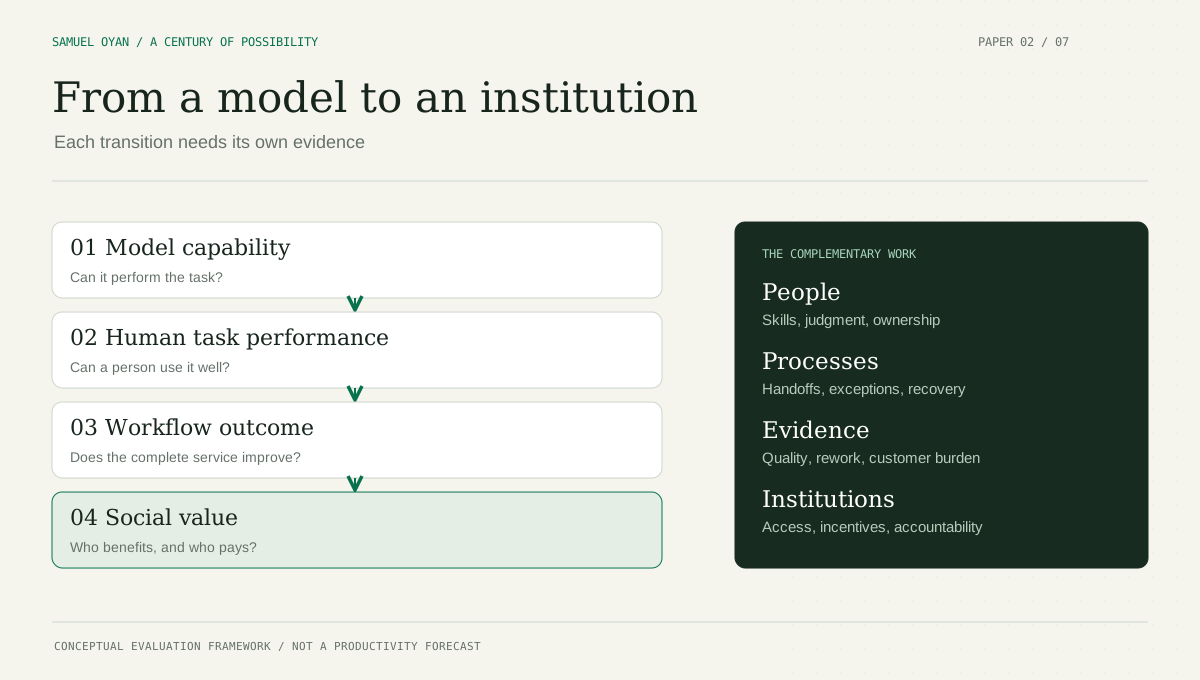
A model can perform well on a benchmark while a business deployment performs badly. Conversely, an imperfect model can be useful in a carefully designed workflow. The difference arises because a benchmark measures selected behavior under specified conditions. A workflow adds real inputs, incentives, permissions, people, delays, and recovery obligations. Social value adds another layer: whether the resulting service actually improves someone’s life.
| Level | Question | Example measure |
|---|---|---|
| Model capability | Can it perform a defined task under test conditions? | Accuracy on a representative, held-out evaluation. |
| Task performance | Can people use it to complete that task well? | Correct completion time, error rate, and verification burden. |
| Workflow outcome | Does the full service improve? | Resolved cases, total delay, rework, and exception handling. |
| Social value | Who benefits, who pays, and who can challenge the result? | Access, customer burden, distribution, and meaningful recourse. |
Consider an illustrative insurance office. A system that drafts a letter in seconds may appear productive. But if staff must spend longer checking fabricated details, correcting inaccessible language, and reconciling mismatched records, the office has accelerated one step while slowing the whole process. The relevant unit is a correctly completed case, with acceptable treatment of the customer, rather than the speed of text generation.
This distinction also prevents a common accounting trick: treating work transferred to someone else as work eliminated. If a customer must repeatedly correct an automated service, the firm may report fewer staff minutes while the customer pays with time and frustration. A credible productivity analysis includes the boundary of measurement. Savings do not become social gains simply by moving off one organization’s ledger.
What workplace evidence actually establishes
Brynjolfsson, Li, and Raymond’s study of 5,172 customer-support agents, published in 2025, reports a 15% average increase in issues resolved per hour after AI assistance, with substantial differences across workers [2]. This is important evidence of value in a defined task environment. It is not a universal productivity multiplier for every occupation, model, or organization.
Research involving 758 consultants describes a jagged frontier: assistance improved performance on some tasks, while capability did not transfer uniformly to others [3]. The practical lesson is not that AI either works or fails as a category. A successful use in one part of a job cannot certify a neighboring task simply because both require fluent language or professional-looking output.
Together, these studies support a more precise hypothesis: AI may help when the system’s capabilities, the worker’s knowledge, and the task’s verification process fit one another. A novice may gain access to examples and techniques previously acquired through experience. An expert may save time on routine preparation. Both can lose ground if convincing output conceals an error they do not know how to detect.
The evidence also has limits. Studies involve particular organizations, technologies, tasks, and periods. A short-run improvement does not settle long-run skill development, competitive effects, or employment. Those questions need additional designs and longer observation. Rigorous enthusiasm accepts a positive result without asking it to carry every possible claim about the future.
The expensive part is often organizational
The productivity J-curve framework explains why complementary investments can precede visible benefits: firms change processes, develop skills, and create intangible assets around a new technology [4]. AI integration follows the same broad logic when an organization must clean records, redesign handoffs, define ownership, and teach staff when to challenge the system. These costs are part of adoption, not evidence that adoption has somehow failed to begin.
Imagine buying a commercial oven for a kitchen with no recipes, no ingredient inventory, and no one responsible for food safety. The oven may be excellent. Dinner is still uncertain. A powerful model in an organization without reliable data or decision rights faces a similar problem. Capability enters a system whose weakest coordination mechanism can determine the result.
This is why workflow redesign deserves more attention than prompt refinement alone. The organization must decide what enters the system, which outputs can proceed automatically, what a reviewer must inspect, and how an exception returns to a person. A pilot without those decisions may discover model behavior while learning very little about the eventual service.
A bottleneck-based theory of adoption
I propose beginning with a valued outcome and working backward. Where is the constraint? It might be reading capacity, access to expertise, missing data, a legal requirement, physical equipment, or a decision nobody owns. AI is relevant when it can move that constraint at an acceptable total cost. When the bottleneck is a broken institution, a better autocomplete system is unlikely to repair it by itself.
An illustrative maintenance desk might struggle because equipment histories are scattered across documents. Retrieval and summarization could make a real difference. A second desk might already understand each fault but lack replacement parts. The same AI tool would have less effect on repair time there. Similar interfaces can conceal different causal structures, which is why copying another company’s pilot is a weak substitute for diagnosis.
Once a plausible intervention is identified, define a counterfactual: what would have happened without it? Compare completed work, quality, delay, and downstream burden. Include cases the system declines and errors it introduces. A team should be able to describe what evidence would cause it to stop, redesign, or expand the deployment. Otherwise the pilot is a marketing event with a feedback form.
The hidden value of exceptions
Routine cases are attractive to automate because they recur. Exceptions matter because they reveal the boundaries of the service. A system that handles ordinary requests well but routes unusual ones badly may impose its greatest costs on people with complex needs. Measuring the average alone can hide that distribution. Operational review should examine who receives the slowest, least accurate, or least contestable treatment.
The human role also changes with the exception rate. If staff see only rare difficult cases, their work may become more demanding rather than easier. They may need more context and greater authority, not a smaller training budget. A plan that automates the easy work while treating the remaining workforce as interchangeable ignores the actual composition of the work left behind.
Access is an architecture problem
Language interfaces can lower barriers for people who do not know an application’s terminology. They can also introduce barriers when they require users to guess the right wording, tolerate opaque errors, or share information they do not understand is being retained. Accessibility therefore includes clear choices, stable alternatives, usable correction, and a route to a human. A conversational interface is not automatically an inclusive one.
Dependence on a small number of providers also deserves attention. A firm can lose bargaining power or continuity when its essential workflows become difficult to move. Interoperable records, exportable configurations, documented interfaces, and an exit plan are practical forms of independence. Infrastructure is dependable partly because its users can survive the failure or replacement of a supplier.
Work changes through decisions, not exposure scores alone
The ILO’s 2025 index estimates that one in four workers globally is in an occupation with some generative AI exposure. The report emphasizes occupational transformation rather than treating exposure as observed job loss [5]. An occupation contains multiple tasks, relationships, and responsibilities. Whether assistance leads to better service, new demand, reduced staffing, or more intensive work depends on organizational and economic choices.
This does not make displacement imaginary. It means its explanation must include adoption cost, demand, labor institutions, and managerial incentives. Workers may reasonably worry even when a technology cannot perform their entire job. Removing a profitable subset of tasks can still change staffing or wages. A serious discussion addresses that possibility without converting a technical capability map into a prediction of inevitable unemployment.
A research agenda for dependable intelligence
Three questions should guide future evaluation. First, do gains persist after the novelty of a pilot fades? Second, do workers retain the knowledge needed to detect failure and handle exceptions? Third, who captures the value after customers, staff, suppliers, and affected communities are included? These questions connect the engineering problem to the social one while remaining open to measurement.
The strongest counterargument is that a bottleneck approach may be too incremental for a technology that enables entirely new products. That is a fair limitation. Some value comes from creating services that previously had no viable workflow. Yet those services still face constraints on trust, distribution, cost, and human attention. The framework should identify those constraints rather than assume all innovation begins with optimizing an existing department.
AI becomes infrastructure when useful capability is delivered with reliable boundaries and an organization that knows how to depend on it. The achievement is less theatrical than a benchmark record and more consequential than a clever demo. It is the quiet conversion of possibility into a service people can actually use, question, repair, and afford.