Abstract
Many important institutions can be understood as systems for making and implementing decisions under uncertainty. AI changes the cost of processing information within those systems, with consequences for finance, government, commerce, and employment. This paper argues that decision efficiency should be evaluated alongside error costs, explanation, recourse, concentration, and the distribution of gains. Drawing on IMF analysis, OECD public-sector cases, labor-exposure research, and workplace evidence, I distinguish assistance, recommendation, and delegated authority. I propose a decision balance sheet that records who benefits from speed, who bears mistakes, and who can secure a correction. AI’s economic importance will depend not only on how many decisions it accelerates, but on whether institutions become more capable of serving the people subject to them.
The hidden product of an institution
A bank appears to provide financial services. A government office appears to process forms. A retailer appears to sell goods. Beneath those descriptions, each organization repeatedly makes decisions: what information matters, whether a request is complete, which case needs attention, and what should happen next. AI becomes economically important when it changes the cost, speed, or quality of that decision work.
The word “decision” should not flatten meaningful differences. Recommending a product, flagging possible fraud, explaining a public service, denying access to money, and transferring funds have different consequences. A model can contribute information without owning the authority to act. The central institutional challenge is to preserve those distinctions when a single interface can move smoothly from explanation to execution.
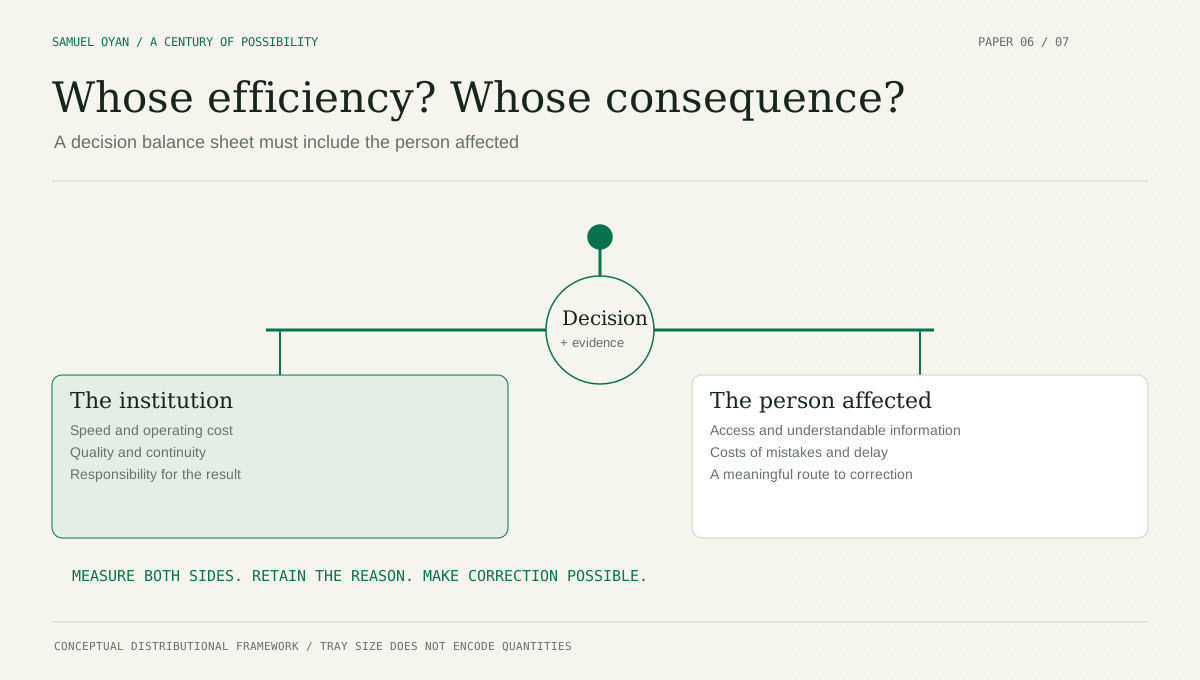
My thesis is that a cheaper decision is valuable only in relation to its outcome and distribution. The institution may benefit from speed while another person bears an error. It may improve consistency while making unusual cases harder to resolve. Good evaluation includes both sides. Counting processed requests is incomplete when the requests concern someone’s home, livelihood, health, or ability to participate in society.
Finance: more useful signals, new forms of dependence
The IMF’s analysis of AI in capital markets identifies possible benefits for risk analysis and market functioning alongside concerns including concentration, opacity, cyber risk, and correlated behavior [1]. This is a map of opportunities and vulnerabilities, not evidence that one technology inevitably stabilizes or destabilizes every market. The effect depends on the application and the surrounding system.
An illustrative fraud-detection tool can help an analyst prioritize suspicious activity. But false alarms can block legitimate customers, while missed events create a different harm. Evaluating the model means examining these outcomes together and considering the appeal process. A system that efficiently identifies unusual behavior may be particularly likely to encounter people whose legitimate circumstances do not resemble the majority.
There is also a difference between reading a financial document and authorizing a transaction. AI may help summarize a statement or identify missing information while a separate controlled process governs movement of funds. Combining the steps for convenience can obscure where authority entered the workflow. A financial institution needs a record of the request, evidence, decision, responsible party, and actual effect.
Shared suppliers create another dimension. If many institutions rely on the same model, cloud service, or data feed, failures may become correlated. This is different from an individual prediction error: the common dependency can affect many systems at once. Diversity, fallback arrangements, and practical exit options therefore belong in the economic assessment, even when the cheapest short-run configuration looks attractive.
Government: the queue is a policy experience
OECD’s 2025 work examines 200 AI use cases across 11 government functions [2]. It establishes a broad range of applications, not a controlled demonstration that all of them improved public outcomes. Potential uses include helping people navigate services and supporting internal work. Their importance lies in the interaction between administrative capacity and citizens’ ability to obtain a fair, usable service.
Consider a hypothetical resident trying to understand which documents an office requires. An assistant that explains the published process in clear language could reduce frustration. But if it invents a requirement, gives different answers to different people, or cannot route an unusual case to an authorized employee, the state has made its service harder to navigate while apparently modernizing it.
This suggests a principle: administrative assistance should make rights and responsibilities easier to understand without becoming an unaccountable gatekeeper. Information should be tied to an authoritative source, consequential decisions should remain attributable, and correction should be possible. These are design propositions in this paper, not a summary of a particular jurisdiction’s legal requirements.
A faster queue remains a queue. If the real problem is an unnecessary procedure, automating the procedure may make a bad arrangement more durable. Institutions should ask whether a step is needed before optimizing it. AI can help reveal duplication or support staff work, but it should not become a decorative screen placed in front of an unresolved policy failure.
Small business: a lower threshold for organizational capability
A small firm may lack a dedicated analyst, translator, technical writer, or software team. AI can potentially help prepare drafts, interpret information, and explore options at lower initial cost. This can widen the range of tasks a founder or employee can attempt. It does not make every generated contract reliable, every financial interpretation sound, or every piece of code secure.
The important economic mechanism is a lower entry threshold for certain kinds of preparatory work. A business can reach a more informed first conversation with a qualified professional or test an idea before committing substantial resources. Some tasks still require specialized judgment, verification, or formal responsibility. The productive relationship may be better preparation for expertise rather than the disappearance of expertise.
The same tools are available to competitors, suppliers, and customers. More efficient production does not guarantee a durable business advantage when everyone can obtain similar assistance. Differentiation may shift toward trustworthy service, proprietary context, distribution, relationships, or the ability to complete work reliably. A founder should ask what remains valuable after competent-looking output becomes widely available.
Employment is a bundle of tasks and a relationship of power
The ILO’s 2025 exposure study explicitly distinguishes potential task exposure from observed job loss and emphasizes transformation of occupations [3]. This matters because jobs include coordination, accountability, physical work, judgment, and relationships as well as information processing. Yet the absence of complete job automation does not guarantee unchanged employment conditions. A reconfigured task bundle can still affect demand, wages, or access to entry-level work.
Workplace evidence reinforces the need for specificity. The customer-support study by Brynjolfsson, Li, and Raymond documents gains in a particular assistance setting, with unequal effects across workers [4]. It cannot tell us by itself whether a different employer will expand service, reduce staffing, raise expectations, or share gains through compensation. Those outcomes involve choices outside the model’s technical performance.
Two organizations can adopt similar systems and produce different labor experiences. One may use assistance to improve training and reduce repetitive burden. Another may increase monitoring, compress deadlines, and remove discretion. The technology influences what is possible; incentives and governance influence what is selected. Describing only the software misses the organization that determines the worker’s day.
A constructive transition therefore requires more than advising people to “learn AI.” Workers need access to relevant training, time to use it, information about planned changes, and opportunities to exercise judgment. Managers need evidence of which tasks improve and which risks are being transferred. Public policy and bargaining arrangements affect whether adjustment costs fall mainly on those least able to absorb them.
A decision balance sheet
I propose that an institution evaluate AI through a decision balance sheet. For each use, identify the objective, the evidence being processed, the action permitted, the cost of different errors, and the person able to correct the outcome. Then examine whether the benefit and burden fall on the same parties. This makes externalized costs visible before a deployment is declared efficient.
| Dimension | Question | Evidence to retain |
|---|---|---|
| Benefit | Which valued outcome improves, and for whom? | Baseline, comparison, quality, delay, and total cost. |
| Error | Who bears false positives, false negatives, and missing context? | Error categories and their distribution across affected people. |
| Authority | Who may recommend, decide, approve, and execute? | Named roles, permissions, and the final decision record. |
| Correction | Can someone meaningfully challenge and repair a mistake? | Accessible routes, response times, reconsideration, and actual resolution. |
| Dependence | What happens if the model or supplier is unavailable? | Fallback capability, portable records, and a practical exit plan. |
For a hypothetical benefits-information service, this might mean measuring correct guidance, time to reach an authorized employee, abandonment, and correction of mistakes. For a fraud workflow, it might mean tracking investigation quality alongside legitimate customers interrupted. These are examples of evaluation design, not claims about measured performance. The point is to connect an organizational metric to the experience of the person affected.
Explanation and recourse are different services
An explanation can help someone understand a result. Recourse means they can challenge relevant information, supply missing context, and obtain a meaningful reconsideration. A system can provide a polished explanation without making any of those actions possible. Transparency is therefore not enough if it merely offers a detailed description of a door that remains locked.
Nor should an institution assume that the AI’s explanation faithfully records the basis of a separate model’s decision. A generated narrative can be plausible without matching the actual process. Records should distinguish evidence, model output, governing rules, human judgment, and the final action. This separation helps reviewers determine what changed and which component needs correction.
The distribution of opportunity
An internet connection does not establish equal ability to use an AI-mediated economy. ITU’s connectivity work documents substantial remaining gaps [5]. Skills, language support, affordability, disability access, and institutional alternatives matter as well. If important services assume a fluent conversation with a paid system, the efficiency of the provider can become a new access cost for the public.
On the other hand, well-designed assistance could help people complete tasks that previously required specialized language or insider knowledge. This is a genuine opportunity. It becomes credible when people can use the service in their own circumstances, understand its limits, and reach help when it fails. Inclusion should be demonstrated in the process, not asserted in the launch announcement.
The objection from speed
A critic may argue that these requirements slow adoption while competitors move ahead. Some requirements do impose cost. The relevant comparison, however, includes the cost of wrong decisions, outages, disputes, and loss of trust. There are low-consequence applications where experimentation can proceed rapidly and high-consequence applications where evidence and recovery capacity deserve greater investment. Proportionality is more useful than treating every deployment identically.
This paper does not predict a single employment outcome, endorse a financial product, or prescribe a universal public-sector architecture. It offers a framework for asking who receives the benefits of computational assistance and who carries its risks. The empirical effects must be studied in each setting and revisited as the technology and institution change.
The economy is made of decisions that become conditions in other people’s lives. AI can help institutions make those decisions with more information and less wasted effort. That is a substantial promise. Its fulfillment will be measured by reliable services, useful opportunity, and correctable mistakes, rather than the sheer number of decisions a system can produce before lunch.