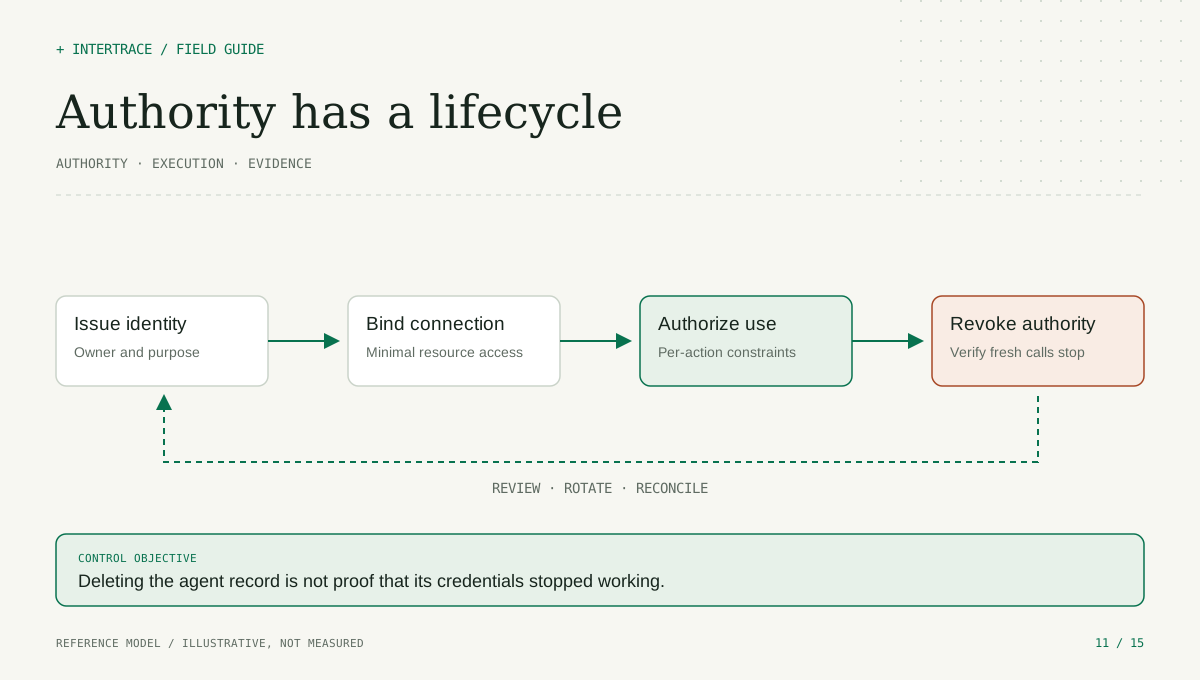
An agent that no longer exists can still possess a working credential. Its deployment may have been removed while a refresh token, shared API key, or copied environment variable remains valid. A lifecycle program that ends at deleting the agent record leaves the most important part unfinished: removing the ability to act.
Treat credential management as a graph of relationships. A workload authenticates to the platform, receives access to selected connections, and reaches provider resources under particular accounts. Each relationship has an owner, a purpose, and a termination condition. The security objective is to make those relationships inspectable and revocable without relying on the model to cooperate.
Give the workload its own identity
Use a stable workload identifier that survives ordinary deployment changes while distinguishing production, staging, and personal experiments. Avoid representing every agent as the founder's API key or the same service account. Shared credentials hide which workload initiated an action and make targeted containment difficult.
Authentication material should be issued to the runtime through a protected mechanism. Store it outside prompts and repository files. Where the environment supports workload federation, prefer that over distributing long-lived secrets. Where static keys are necessary, scope them tightly, rotate them, and make the limitation visible.
Keep the human initiator separate from the workload identity. An employee can start a task without granting the agent all of the employee's standing permissions. Conversely, a background agent may continue after the initiating employee changes roles. Both cases need an explicit delegation model rather than an assumption that the current token implies current business authority.
Separate three kinds of authority
The runtime credential authenticates the workload to a service. The provider connection makes a downstream account available. The action grant defines what the workload may do through that connection. These are related objects with different lifetimes and revocation paths.
Short-lived runtime credentials reduce exposure if copied, but they do not constrain a broadly privileged provider connection by themselves. Narrow action grants limit use through the mediated path, but cannot restrain a raw provider token that has escaped to a different machine. The deployment must enforce the relationship between all three.
Record the connection owner and business owner separately where appropriate. An integration administrator may maintain the OAuth application while a finance manager owns the workflow's permitted actions. A change of owner should trigger a review of delegated authority, not silently transfer the old owner's privileges to a new name.
| Event | Control change | Verification |
|---|---|---|
| New workload | Issue identity and minimal bindings | Correct tenant and environment |
| Role or scope change | Recompute effective grants | Old capability no longer works |
| Credential rotation | Replace material and expire overlap | Old credential is rejected |
| Workload retirement | Disable identity and bindings | No fresh action can execute |
Design rotation for real systems
Rotation is a migration with failure modes. The new credential may not have propagated to every instance. A cached client may keep the old value. A background worker may retry an operation during overlap. Define the cutover, overlap duration, rollback condition, and signal that proves the old credential stopped working.
Use identifiers or fingerprints in logs rather than credential values. An operator should be able to determine which credential generation served a request without exposing the secret. Keep audit records long enough to investigate misuse after rotation, and limit access to diagnostic artifacts that could contain headers or environment dumps.
OAuth refresh tokens need their own lifecycle. Disabling an agent's runtime key is not the same as revoking the shared provider connection. Decide whether the provider connection remains available to other agents and whether its refresh token requires rotation. Provider revocation behavior varies; test it against the actual integration rather than assuming immediate invalidation everywhere.
Specify revocation latency
Revocation is a distributed systems problem. A control-plane change may need to reach policy caches, gateway instances, token validators, workers, and provider sessions. Measure how long each path can continue authorizing new actions after disablement.
State a bounded objective for high-consequence actions. Depending on the deployment, that may require short token lifetimes, versioned grants, push invalidation, or online checks. When state is unavailable, the fallback must respect the risk class. A stale allow decision should not become indefinite authority during an outage.
Revocation cannot retroactively undo a completed external action. It may also be unable to cancel an operation already accepted by a provider. Distinguish stopping fresh calls from canceling queued work and recovering completed effects. The incident procedure should say which mechanism owns each outcome.
Make offboarding a sequence with proof
First disable the workload identity and remove its action grants. Then cancel queued jobs and invalidate unconsumed approvals or execution permits where supported. Remove connection bindings and determine whether downstream credentials were shared, exposed, or independently usable. Revoke or rotate those credentials accordingly.
Preserve the mapping needed for an investigation. Deleting identity history to clean up the inventory can make past actions unattributable. Mark the workload retired while retaining authorized audit evidence and the policy revisions under which it acted. Apply the organization's retention and privacy requirements to that evidence.
Finally, run a controlled negative test using the retired identity against each material execution path. A disabled dashboard toggle is not sufficient proof. Verify that direct provider access, local hooks, queued workers, and alternate environments no longer create fresh effects outside the intended residual permissions.
Watch the lifecycle itself
Alert on unowned connections, credentials with no recent legitimate use, workload identities active after deployment retirement, and privilege expansion without a review record. Investigate unusually frequent token refresh failures as an operational signal; do not automatically interpret every refresh failure as an attack.
Review administrative changes with the same care as runtime actions. Editing a tenant binding or replacing a connection can silently redirect many future calls. Require appropriate authorization, preserve before-and-after values without secrets, and link the change to the responsible administrator.
The durable outcome is an answer to a practical question: if this agent is compromised or retired now, which exact controls stop its next action, how quickly do they take effect, and how will the team prove they worked? A credential inventory becomes a security control only when that answer is testable.